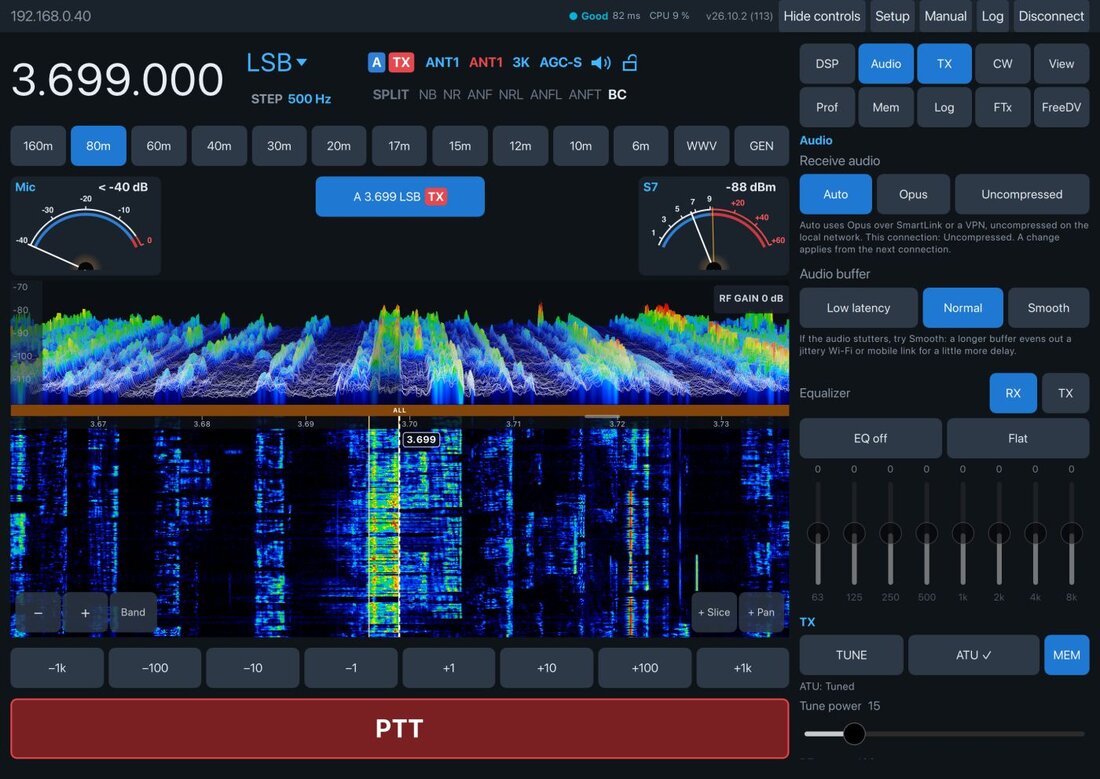
I'm a radio amateur, callsign OH6OKSA. At the start of October I wanted to use my FlexRadio from an iPad, with no computer in between. There was no app for that, so I made one. Sixteen days passed from the first line of code to build 115. The app now runs on iPhone, iPad, Mac and Android, more than 60 people test it, and the user group gained over 170 members in five days.
The starting point
FlexRadio's software-defined radios are usually operated from a computer program. The open-source AetherSDR is one such program. My idea was to take its radio engine and build on it an app made for the touch screen, one that talks to the radio directly over the network, at home or remotely over the internet. At first it was simply "the iPad port"; a week in, it got its name, OksaSDR.
Timeline
- 10 Oct The first prototype on the AetherSDR engine
- 11–12 Oct The first TestFlight builds for iPad and iPhone
- 13–15 Oct The first outside testers; the 3D spectrum, CW keying and remote operation (SmartLink)
- 17 Oct The name OksaSDR and the first Android beta
- 20 Oct The users' Facebook group opened
- 21 Oct A logbook in the app
- 23 Oct FT8/FT4 digital contacts and RADE digital voice straight from the app, no computer needed
- 24 Oct Links to Wavelog, Cloudlog and PSK Reporter, transverters, the two-screen iPhone
- 25 Oct New meters, the FreeDV station list, large logbooks, and build 115 / Android beta 31
Sixteen days added up to 345 changes and about 28,000 lines of the app's own code. In 30 days the TestFlight testers opened the app close to 2,000 times.
AI on the development team
Most of the code was written by AI, Anthropic's Claude Code, under my direction. My own role was that of product owner and project manager: what to build, in which order, and when something was ready to ship. Every build was tested on a real radio before release, and the user manual with its screenshots was updated in the same release.
AI did not remove the need for judgement. It moved the work from writing to deciding and checking. The bottleneck was no longer how fast code gets written, but how well you can say what you want and tell whether it works in real use.
Users involved from day one
The first test build reached testers on day two. Since then nearly every change has come from user feedback: a message, a screenshot or a log file, then a fix and a new build, often the same day. Testers found things I could never have found alone, on equipment I don't have: other radio models, foldable phones, Macs and a two-screen iPhone.
The Facebook group grew to more than 170 members from many countries in five days. It became the most important tool of the development: that is where problems are reported, improvements suggested and new builds announced first.
What business can learn from this
- Small releases often beat big releases rarely. A short cycle brings feedback in time, while a change is still cheap to make.
- The customer finds what the team does not. Real users in real environments are the best quality assurance.
- AI changes the economics of development. One person with domain knowledge can deliver what used to take a team. The value moves to decisions, priorities and quality, in other words to leadership.
- A community is an engine for growth. The same principle as in a partner network: when people are heard and see it make a difference, they bring in the next ones.
The common thread
OksaSDR is a hobby project, but it was built on the same principles as B2B business development: a clear goal, a fast feedback loop, measurable results and people involved from the start. What is new is the pace that AI makes possible when it is led well.
The app is free. More information and the source code: github.com/OH6OKSA/OksaSDR.